CONNECTING THE DOTS . . . .
We know we are all ‘where we are’ because of the decisions we have made throughout our lives.
Aside from those inevitabilities in life (and we all experience those) we are the result of all of the choices we have made given the events that have occurred: the achievements, the failures, the good paths we’ve taken, the wrong turnings, the times we’ve bombed out, fallen by the wayside or succeeded beyond our wildest dreams.
No doubt you too have come to the conclusion that life is somewhat of a rollercoaster ride!
What we have all created in our lives is a string of memories; this is the foundation of our knowledge.
We interpret our memories, our perceptions and analysis of the things that have happened and this becomes the core of our critical thinking.
Over the years (depending on how long we have been on this Earth) we have collected a series of “dots”; a range of experiences, good and not-so-good, that have affected our thoughts and decisions and brought us to this point in our lives.
I don’t know about you but I have looked back over my ‘chequered career’ of a life quite a few times and have realised that I wouldn’t be where I am right now if it weren’t for certain things that had happened (or not happened): the highs and the lows and everything in between.
There are some things I wish hadn’t occurred or I wish I hadn’t done, but I would not have been without the many lessons those experiences have taught me. And amidst all of those lessons, possibly the greatest one for me has been to work in the best way possible with ‘what is’.
We cannot change the past, but we can change our attitude. Something good comes out of every situation.
The point of saying all of this is to suggest that taking time out to consciously “connect our dots” is a very worthwhile exercise.
Of course, we all have a range of very different experiences, but also, we don’t always “connect our dots” the same way. Everyone does it differently.
You probably know all of this, but sometimes a reminder can put things into perspective or trigger something that is of value in the present.
- Our memory, recalling our “dots”, is the foundation of our critical thinking. Without memory we have no knowledge.
- We can’t remember everything, but it is important to remember vital bits of information, not only to help us, but also to help us see other people’s perspectives.
- This is a great way to fully appreciate the ‘bigger picture’, recognising patterns and connections, helping to give us a greater understanding.
- We know how important play is in children helping them to problem-solve. In adult life, “connecting the dots” is just as important for our problem-solving skills.
- Some of your “dots” – patterns, connections and ideas – may need re-thinking and adjusting to suit current needs but that’s how we learn. Then we can successfully set our goals for the future.
- Attention and focus are important in anything we do and particularly in regard to our memory and recall. We live in an age where social media is designed to steal our focus. Often keeping, or regaining, our focus and attention can be difficult. (A great read is Johann Hari’s book “Stolen Focus, Why You Can’t Pay Attention”)
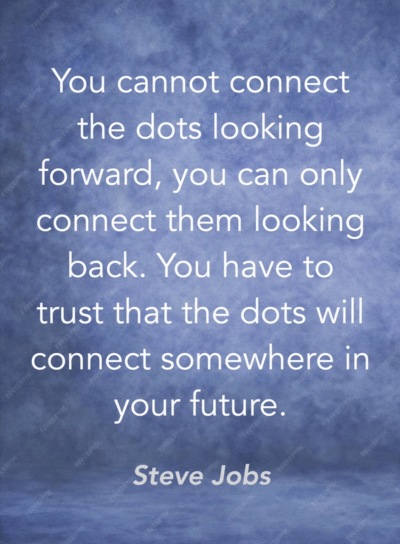
In the box below is a quote from Steve Jobs. There was a follow-on to his comment where he said we need to “trust our gut”. The more we are in touch with ourselves, the more we are likely to make better decisions.
Enjoy “connecting your dots”. Have a great month. With Love and Laughter,