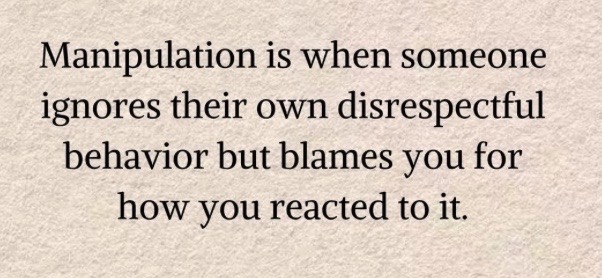
MANIPULATION….IN MANY FORMS
If we have ever felt manipulated by someone else’s behaviour, we would be aware of a feeling of anxiety and confusion; we may feel drained, with a sense of loss of our personal power.
This seems like such a heavy subject but it is an important one. It is something we have all experienced at some time.
Manipulation can happen in close relationships, with friends and family members, within a community group or in the workplace; realistically, in any situation.
We certainly hear about it in issues of domestic violence, where such tactics as gaslighting (convincing someone to doubt their own sanity), guilt-tripping, emotional blackmail, playing the victim, blaming, laying on the charm, etc. can be used to achieve the manipulator’s ultimate goal.
These tactics may seem obvious to some, but manipulation can be very subtle and sneaky. It is very important to keep up our awareness.
It can be difficult to admit that we have been (or are being) manipulated, particularly when it is by someone who is close to us. Manipulation can take a huge emotional toll; we need to find a safe way out.
A reminder that those who are more likely to be manipulated are often:
- ‘people pleasers’ who like to make others happy
- those who may seek others’ approval
- people who tend to stay in relationships even if they’re unhappy in them
- those who often find themselves saying “yes” when they really want to say “no”.
It is also important to accept that it is not our fault that we are being manipulated. Those who manipulate can be absolute masters at playing on our weaknesses (and we all have them). They can lie, twist the facts, or distort a situation to have us believing the opposite of what is going on.
Once we realise what is happening, it is vital that we put some strategies in place.
Putting some distance between us and the person who is trying to pressure us into doing what they want is not always as easy as it sounds, particularly in a close relationship. Some ideas:
- Where possible, limit how often we connect with this person. This will make it easier to keep the relationship at an acceptable level, but we may also need to stop all contact.
- Don’t share too much with this person. The more a manipulator knows about us, the more that information can be used against us. Keep conversations fairly brief.
- Having a series of ‘one-liner’ unemotional answers in our cache is a great idea; respond in a neutral way so as not to play into the drama they are trying to create.
- Take a moment (and a good deep breath) before responding to what a manipulator is asking of you. Stand back and take stock of what they ask.
It is also very important that we set firm boundaries. I wrote a newsletter two years ago entitled “Drawing the Line Politely”. For those of you who are new to my newsletters, may I suggest you look it up on my website – https://heleneveringham.com/2023-07-july-newsletter/ ?
This is where keeping up our good Self Esteem is vital. When we have a high regard for ourselves and our well being, we will be more inclined to set and keep firm boundaries.
In this regard, we need to be mindful of what we are prepared to tolerate; we are effectively teaching people how to treat us.
Remember, no one can manipulate us without our allowing it to happen.
As always, Love and Laughter,